Matera from the masseria
An hour and ten minutes on the road, to a city like nowhere else. It's the longest day trip of the stay — here's how to make it enjoyable rather than exhausting.
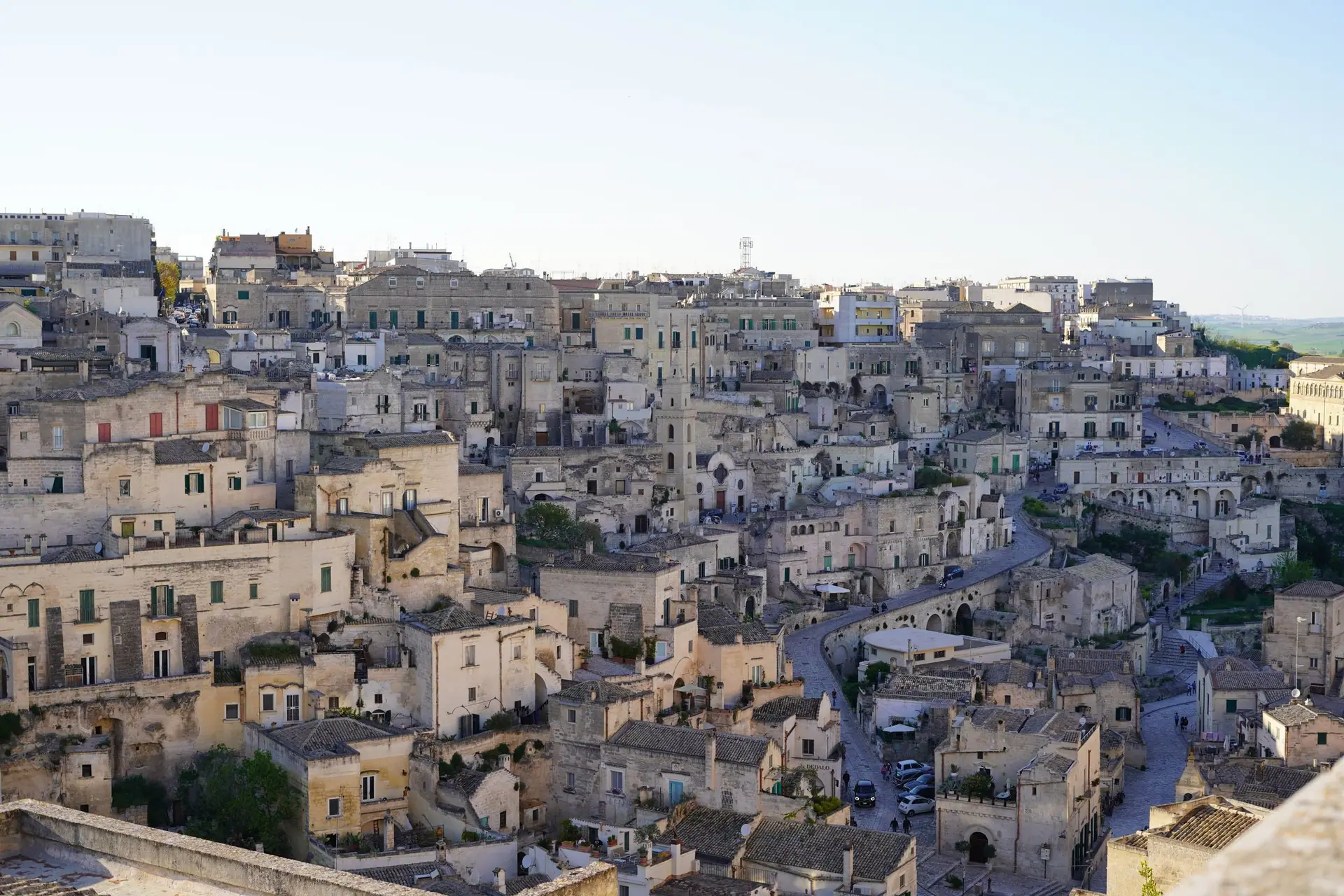
Is it really worth the trip?
Let's start with the question nobody quite asks out loud, because the obvious answer would be "of course." It deserves a more honest one.
Matera is an hour and ten minutes away by road. The round trip means two and a half hours of driving within a single day — by far the most time any excursion in this guide costs you. Over a week's stay, it eats up an entire day, and there's no halfway version: you don't just "pass through" Matera.
That said, yes, it's worth the day. Because there's nothing else quite like it. This isn't a variation on Puglia's whitewashed villages: it's a city carved into a limestone ravine, inhabited without interruption since prehistoric times, where the houses are as much excavated as they are built. You come away with the sense of having seen something genuinely unique, which doesn't happen every day.
Our advice, then: yes, but once, and only if you give it the whole day. Don't try to squeeze it in between two swims.
What the Sassi actually are
The Sassi — literally "the stones" — are the two historic quarters carved into the side of a ravine. The dwellings here are troglodytic: the rock was hollowed out first, and façades added afterwards, so a house is often half cave, half construction.
The recent history is worth knowing, because it changes how you look at the place. In the mid-twentieth century, these quarters were seen as a national disgrace, unsanitary and overcrowded, and their residents were forcibly rehoused in new districts. The Sassi stood empty for decades. Their restoration, and later their inscription as a UNESCO World Heritage Site, completely reversed that status.
In practice, visiting means walking down into the ravine and back up again. The lanes are staircases, the squares are rooftops, and it takes a while to grasp the vertical logic of the place. Good shoes aren't a luxury here.
The day, hour by hour
The plan we'd suggest accounts for the drive: leave early to have the whole morning there, take a relaxed lunch, and head back before fatigue sets in.
Three things to know
First, the heat. The Sassi are entirely stone, with no trees and no shade, and the rock holds the sun's heat all day long. In July and August, the afternoon is genuinely tough going: save the walking for the morning, and keep early afternoon for an indoor visit or a viewpoint.
Second, footwear. The city is one giant staircase, often stone worn smooth by centuries of use and sometimes slippery. This isn't the day for sandals.
Third, the car. The historic centre is tightly constrained and largely closed to traffic. You park in the upper town and walk down — keeping in mind that you'll have to climb back up at the end of the visit, which is a good deal less fun.
Frequently asked questions
- Is Matera in Puglia?
- No. Matera lies in Basilicata, the neighbouring region. It's very often grouped with Puglia in travel itineraries because it sits close to the Adriatic coast, but administratively and culturally, it belongs to a different region.
- How long does it take to get to Matera from Polignano a Mare?
- About an hour and ten minutes each way, or close to two and a half hours of driving across the day. It's the longest excursion from this part of the coast.
- Can you visit Matera in half a day?
- Technically yes, but we wouldn't recommend it. With two and a half hours spent driving, a half-day would leave barely two hours on site — too little for a city you explore by walking down into a ravine and back up again. Better to give it the whole day, just the once.
- What exactly are the Sassi?
- The two historic quarters of Matera, carved into the limestone of a ravine. The dwellings there are partly excavated from the rock and partly built, and the site has been continuously occupied since prehistoric times. They're inscribed as a UNESCO World Heritage Site.
- What's the best time of day to visit?
- The morning, especially in summer. The Sassi are entirely stone, with no shade, and the rock radiates back the heat it has absorbed: afternoons in July or August are hard going there.
One hour ten from the Sassi
Masseria 1863 is a countryside house for eight guests, with its own pool and olive garden, between Polignano a Mare and Monopoli.