What to do in Polignano a Mare
Ten minutes from the masseria, an old white town perched above the Adriatic — the kind of place people build a week in Puglia around. Here's what there is to see, and how to enjoy it without the crowds.
Why Polignano a Mare
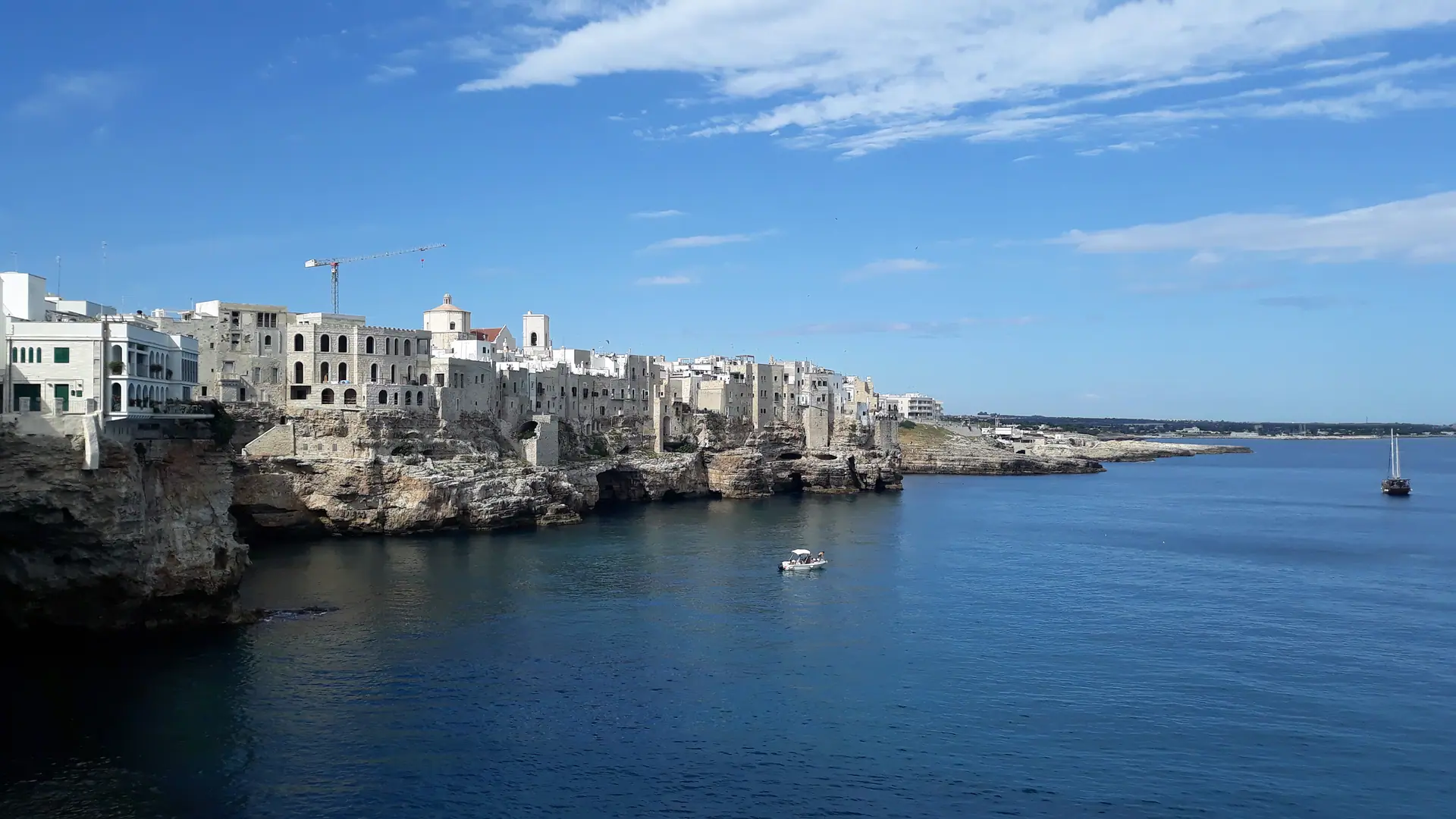
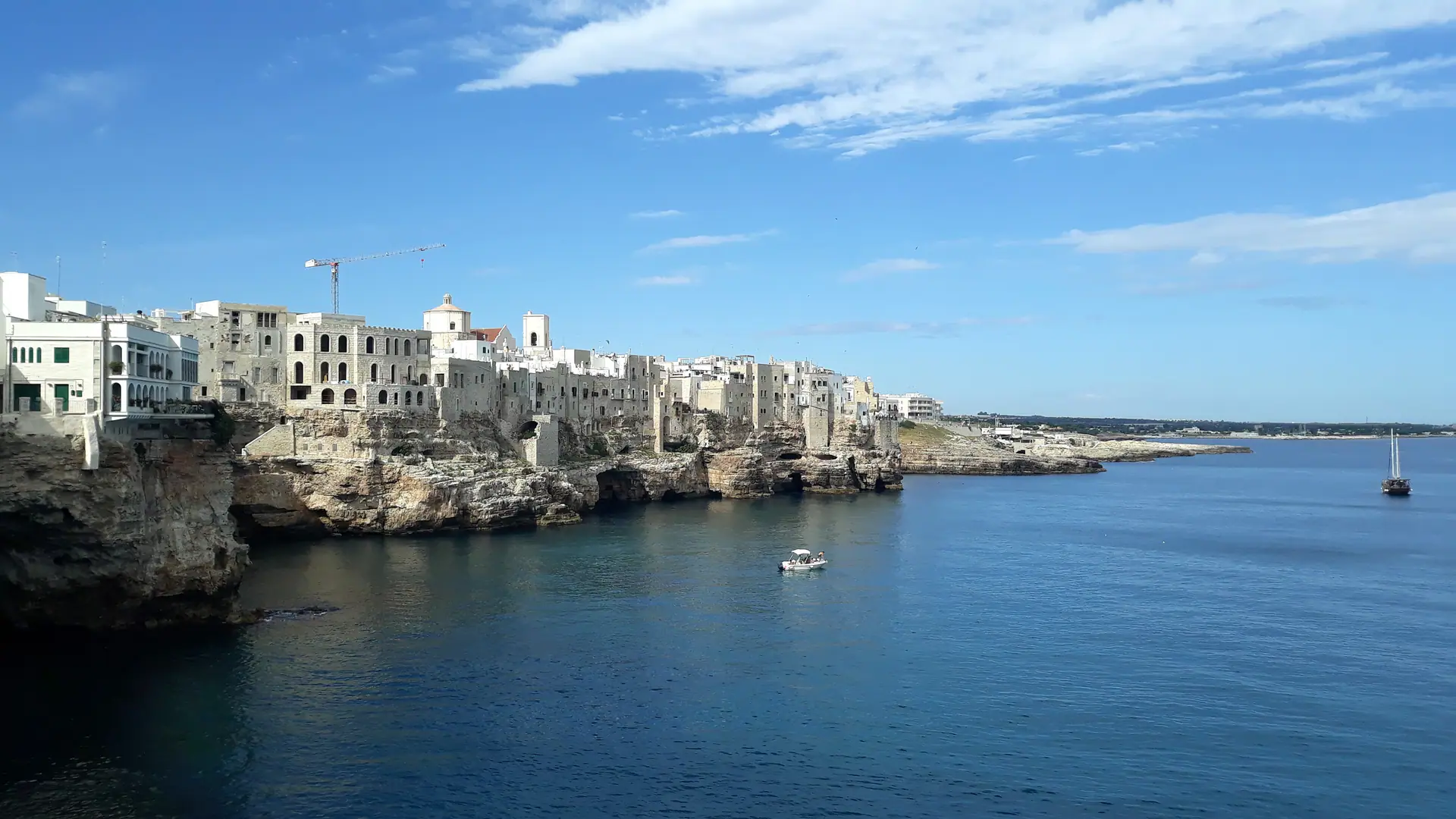
Along Puglia's Adriatic coast there are plenty of whitewashed villages and plenty of beautiful water. Polignano a Mare stands apart for one thing the others don't have: it isn't beside the sea, it's above it. The old town sits on a limestone plateau that drops straight into the water, twenty to twenty-five metres below. From the terraces, you're not looking out over a beach — you have open air under your feet.
That cliff isn't just scenery; it explains everything else about the place. It's riddled with around eighty caves, carved by the sea into soft rock, several of them opening directly beneath the houses. It's cut through by 'lame' — old riverbeds running down from the plateau to the sea — and where they meet the water, they form the only coves you can reach on foot. And the rock made the town in the first place: it was a natural defence, which is why a Greek settlement called Neapolis took root here, later Polineanum under Rome.
The result is a town that reads in three layers, stacked one on top of the other. At the bottom, very clear water, in pebble coves that have nothing of the standard beach about them. In the middle, the rock, its caves and arches. At the top, whitewashed lanes where you can wander for a long while without ever losing sight of the sea — it reappears at the end of every passage, framed like a painting.
That verticality is what has made Polignano what it is today: a small town of seventeen thousand people that, in summer, receives far more visitors than it has residents. It's worth saying plainly, because it changes how you should go about seeing it. Polignano isn't a place to discover at three in the afternoon in August. It gives itself up early in the morning, late in the evening, and out of season — worth bearing in mind if you're weighing up when, in a longer Puglia trip, to spend your time here.
The old town and Lama Monachile
You enter the historic centre through the Arco Marchesale, which locals call the Porta Grande. Until the nineteenth century it was the only way into the fortified town — everything that came into Polignano passed under this arch. It now opens onto a square and a tangle of whitewashed lanes best explored without a map; the centre is small, and you won't stay lost for long.
At the heart of the maze stands the Chiesa Matrice di Santa Maria Assunta, dedicated to the Virgin in 1295, which holds among other things a Nativity carved by Stefano da Putignano. Two more churches are worth a look on the way, one dedicated to Purgatory and the other to Saint Stephen. And in the former municipal slaughterhouse, a little off the main path, the Museo Pino Pascali shows contemporary art — an unexpected counterpoint, and a good refuge when the sun is at its strongest.
But what you're really here for are the viewpoints. The lanes open regularly onto terraces suspended over open air, the best known of which carries the name of Domenico Modugno. From there, the town shows itself in profile: white houses hanging over the rock, the caves below, turquoise water in the cove.
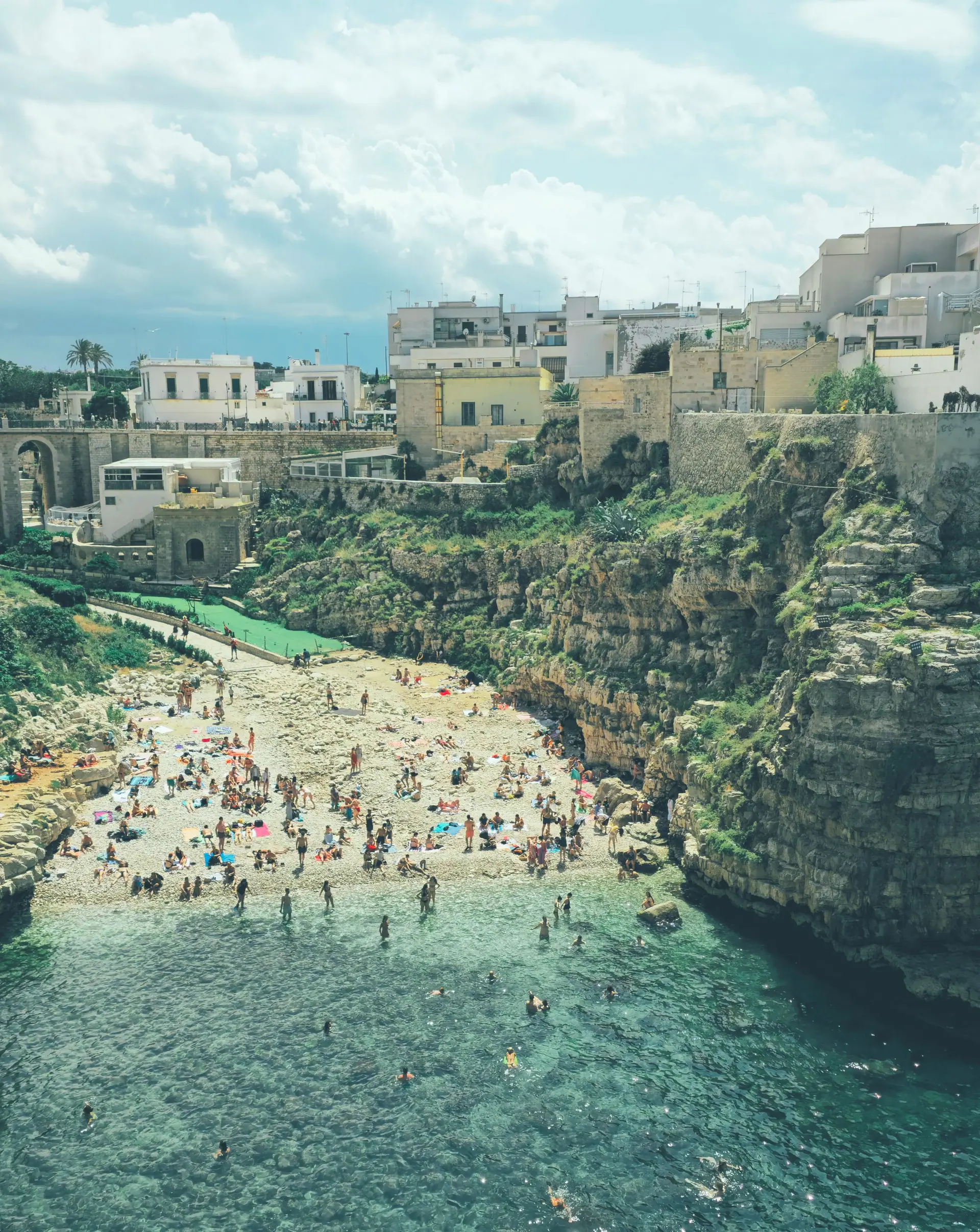
That cove is Lama Monachile, also known as Cala Porto. Italy's official tourism board presents it as the best-known beach in Polignano, and perhaps in all of Puglia. It isn't sand: it's a bed of round pebbles, wedged between two rock walls, where an old river once met the sea. Its name is thought to come from the monk seal, which used to frequent this coast until the Middle Ages and has since vanished from it.
A stone bridge from the nineteenth century, built under the Bourbons and restored in 1997, crosses above it, and everyone stops on it. Higher still runs the route of the Via Traiana, the road the emperor Trajan had built in the second century to connect Benevento to Brindisi. In a single glance, then, two thousand years of passages stacked one above the other over the same cut in the rock.
The sea caves
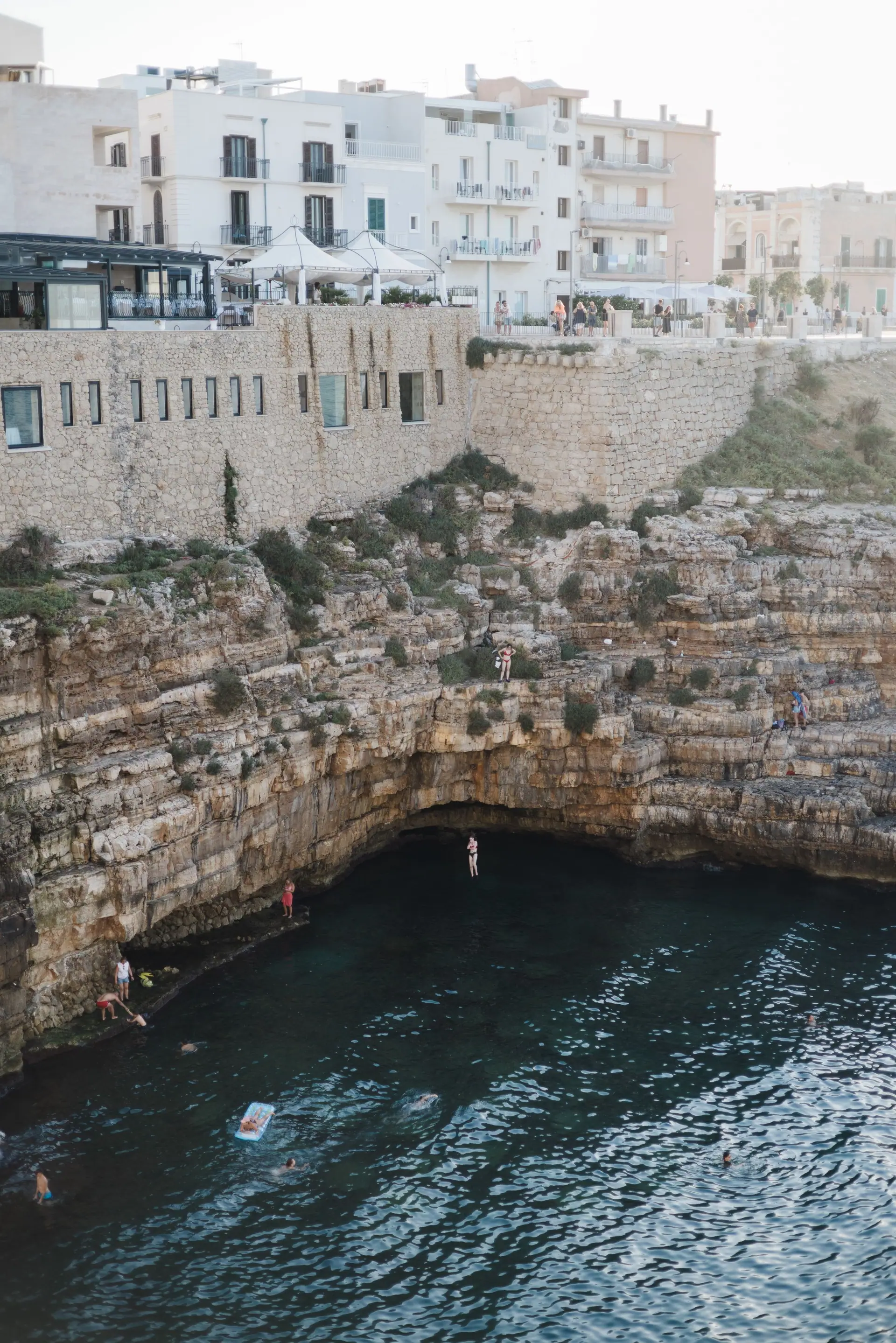
Polignano's cliff is hollow. The coastline holds around eighty natural caves, opening at sea level or just above it, and it's probably the most singular thing the town has to show. Some carry names worth remembering: the Grotta delle Rondinelle, the Grotta Ardito, the Grotta dell'Arcivescovado, the Grotta delle Monache.
The best known is the Grotta Palazzese, a semicircular cavity around thirty metres across, open to the sea beneath the houses of the centre. It now houses a restaurant built into the rock — a well-known address, one that needs booking a long way ahead if it interests you.
The one thing worth knowing as a visitor: most of these caves have no access from land. You see them from the sea, and no other way. Italy's official tourism board recommends boat, kayak or paddleboard; the trips set out from the shore and run along the base of the cliff. It's by far the best way to understand the geography of the place — seen from below, the town looks nothing like what you take in from the lanes above.
One sensible piece of advice: the sea here is only calm in good weather, and outings get decided day by day depending on the swell. If seeing the caves matters to you, plan it early in your stay rather than towards the end. That way you keep a few spare days in hand.
The coves and beaches
Polignano has no long stretch of beach. It has coves, scattered on either side of the centre, and that's a difference in kind, not just degree: you don't spread a towel wherever there's space, you choose your spot. The town's stretch of coastline holds around ten of them, from north to south — Cala Porto, Cala Paura, Porto Cavallo, Ponte dei Lapilli, San Giovanni, Porte Contessa, San Vito, Cala Fetente, Pozzo Vivo, Port'Alga and Torre Incina.
The best known, including Lama Monachile and Cala Paura, are public and free to access. That's also what makes them busy: they're a short walk from the centre, everyone goes there, and in summer they fill up early.
Italy's official tourism board gives a two-part recommendation, and it's the right one: arrive early in the morning, or head north, where the coves are noticeably quieter. It's the best trade-off there is. A northern cove on an August morning at ten o'clock bears little resemblance to Lama Monachile at the same hour.
Two honest points, to avoid disappointment. First, these are coves of pebbles and rock, not fine sand — water shoes genuinely change the comfort of a visit, particularly with children. Second, natural shade is scarce: the cliff gives some in the morning on one side and in the evening on the other, and none through the middle of the day.
Domenico Modugno, the town's own son
You can visit Polignano without knowing anything about Domenico Modugno. You'll understand less, though, about why his name is everywhere: on the main viewpoint, on the walls, in the shops, and even in the way the town talks about itself.
Modugno was born here. He wrote and sang 'Nel blu dipinto di blu', known the world over as 'Volare' — a song whose subject is, literally, flying through the blue. That it should have been born in a town built above open air, facing a blue sea, is no convenient coincidence: it's the landscape itself.
A three-metre bronze statue, the work of sculptor Hermann Mejer, stands on the seafront, arms open, facing the water. It's the most photographed meeting point in town after the bridge. Go at sunset: the light catches the statue face-on and the sea behind it, and you understand at once what the song was reaching for.
Cliff diving
Since 2009, Polignano has hosted the Italian leg of the cliff-diving world championship. Divers launch from platforms set twenty-one and twenty-seven metres above the sea, from the very rock the old town is built on, and land in the water between the two walls of the cove.
The event has done a great deal for the town's profile, and it has become something of a trait: Polignano is one of the few places in the world where a sport like this is contested not in a stadium, but in the everyday backdrop of the people who live there, among the houses and terraces.
If you happen to be there during the competition, know what to expect: the town is packed, the viewpoints are claimed hours in advance, and the centre is hard to reach by car. It's a striking moment, but not the best weekend for a quiet first look at Polignano. The dates change every year; check them with the organiser before building a trip around them, either way.
Where to eat, and what
We won't give a list of addresses. Restaurants open, close and change hands; a list written today would be out of date within a couple of years, and you'd be the last to find out. The categories, though, don't move — and knowing which ones exist is worth more than a name.
There's the clifftop table first: the terraces open to thin air and the dining rooms carved into the rock, of which the Grotta Palazzese is the extreme example. There you're paying for the view as much as the plate, which is a perfectly legitimate choice — as long as you make it knowingly, and book well ahead.
Then there's the back-lane trattoria, in the old town, serving Puglian cooking without any staging: orecchiette, vegetables, whatever fish came in that day, local olive oil. That's where what you pay and what you eat line up best.
And finally there's what you eat standing up, which is a good part of the pleasure of being here: coffee granita, gelato, and focaccia — the Puglian kind, thick, topped with tomato and oregano, sold by weight to take away. A focaccia on a terrace above the sea, late in the afternoon, is a perfectly defensible lunch.
A word, finally, on the countryside, since that's where we're writing from. Around Polignano, the land carries olive, fig and almond trees, and the local markets follow the seasons closely. Shopping at the market and cooking dinner at the house isn't a fallback when you're staying in the countryside — it's often the best meal of the week.
A day from the masseria
Here's how a day that starts and ends in the countryside actually works. It holds for the warmer months, and it's built on a simple principle: see Polignano when it's livable, and retreat to the countryside when it isn't.
Early morning, you head down to the sea. It's when the coves are calm, the light is still low across the cliff, and you can park without thinking about it. A swim, a coffee taken standing up, and the old town almost to yourself: the lanes are cool, the shops are opening, the terraces are free.
By late morning, the town fills up. That's the moment to leave it, and the ideal time for a boat trip along the cliff if the sea allows — you see the caves, and you're out on the water just as the centre gets crowded.
In the afternoon, you head back. That's the real luxury of staying in the countryside: while Polignano is at its busiest, you're in the shade, in the pool, under the olive trees, taking the siesta the climate calls for. There's nothing to see between two and five in the afternoon that you won't see better later.
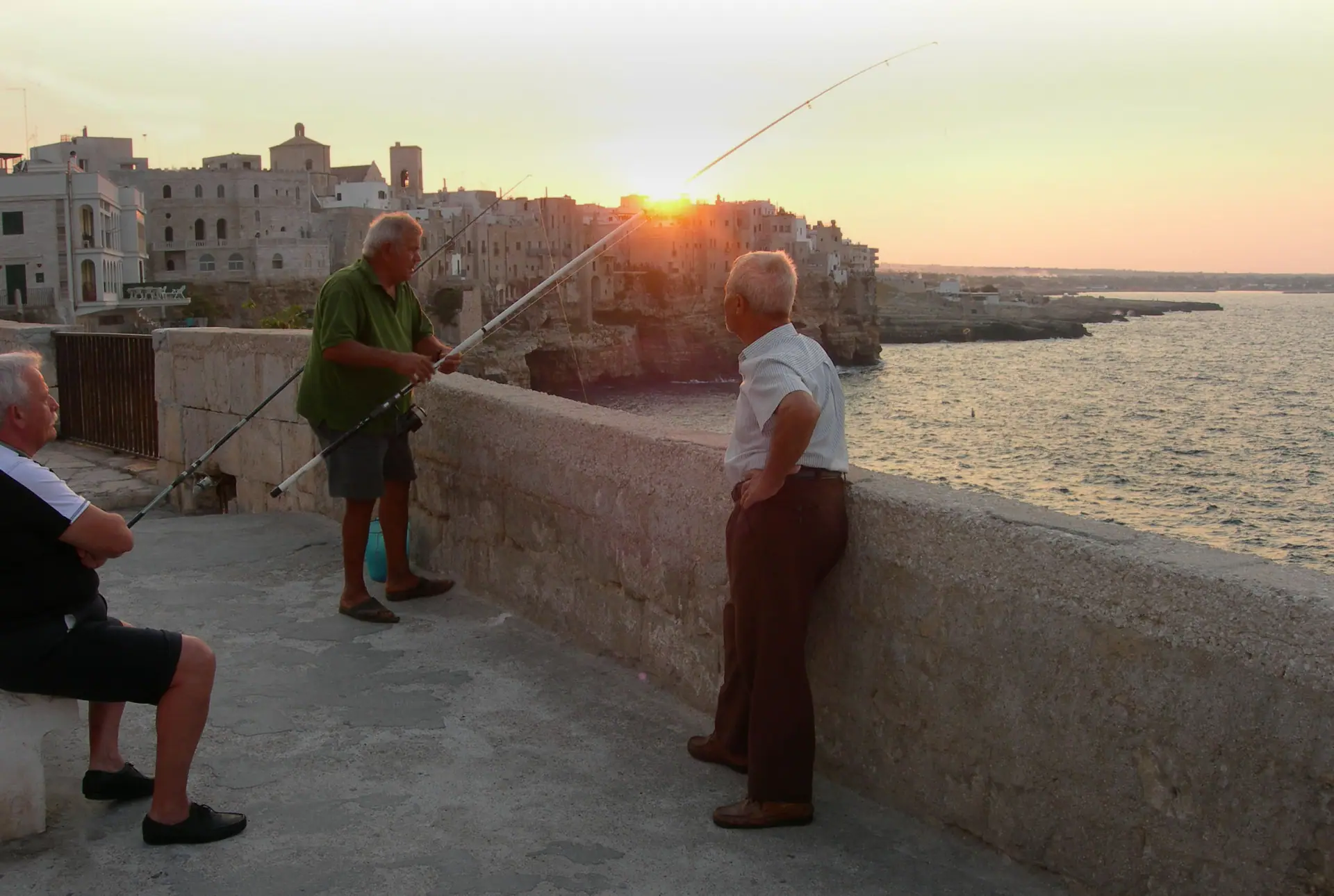
Towards evening, you go back down. The evening passeggiata is the best moment of the day in Polignano: the light turns golden on the white stone, the Modugno statue catches the sun face-on, the terraces above open air fill up slowly, and the temperature turns bearable again. You have dinner in town, or head back up to eat outdoors at the house — and the countryside, at night, is completely silent.
When to go
The climate is Mediterranean: mild, rainy winters and long, hot, sunny summers. That gives a usable season much wider than the one most visitors actually come in — worth knowing if you're weighing up when, within a longer Puglia trip, to build in time here.
Spring and early autumn are, without much argument, the best times to see Polignano. The heat stays manageable through the whole day, the countryside is green, the coves are reachable without setting an alarm before dawn, and the town still feels like a town rather than a backdrop. It's also when the light falls best on the white stone — a comfortable stretch to anchor a longer itinerary around, if your dates have any flexibility.
Summer works too, but it asks for a bit of discipline with timing: early morning and early evening, the town is at its best; through the middle of the day, it's hot and full. That's exactly what the day described above is built to manage. It isn't a real burden once you plan around it — it's simply the local rhythm, and one that suits a longer stay spent moving slowly between the coast and the countryside rather than rushing from sight to sight.
Winter, finally, has its own following, and for good reason. The cliff under a stormy sky, empty lanes, a rough sea at the bottom of Lama Monachile: it's a different town, starker and more real. You just have to accept that a lot slows down, and that swimming stops being the point.
One thing holds true whatever the season: in this part of Puglia, a car isn't a convenience, it's a necessity. The coves, the surrounding towns and the countryside can't be reached any other way — worth factoring in if Polignano is only one stop on a wider loop through the region.
Frequently asked questions
- How many days do you need to see Polignano a Mare?
- Half a day is enough to see the old town, the bridge and Lama Monachile. Allow a full day if you add a boat trip out to the caves and an afternoon at a cove. Using it as a base for a longer stay is a different calculation: you come back several times, at different hours, and that's by far the best way to get to know it.
- Is Polignano a Mare crowded?
- Yes, through the middle of the day in high season. It's a small town of around seventeen thousand people that receives a huge number of visitors, and space is limited by the cliff itself. The fix is about timing, not geography: early morning and late afternoon, the same town is calm. Italy's official tourism board recommends arriving early at Lama Monachile, or heading north to the quieter coves.
- Should you choose Polignano a Mare or Monopoli?
- They're neighbouring towns, complementary and only minutes apart by road. Polignano is dramatic: the cliff, the caves, the drop below the terraces. Monopoli is flatter and more lived-in day to day, with a proper harbour and a larger centre. If you're staying in the countryside between the two, the question doesn't really arise — you'll do both within the same week, likely more than once, as part of a wider Puglia itinerary.
- How do you visit the sea caves?
- By sea. Most of the roughly eighty caves along the coastline have no access from land: you see them by boat, kayak or paddleboard, setting out from the shore. Outings depend on the state of the sea, which can change quickly here — plan them early in your stay so you keep spare days in hand.
- Can you get by without a car in Polignano a Mare?
- In the old town, yes: it's small and walkable. For everything else, no. The coves are strung along the coastline, the nearby towns are fifteen to forty minutes away, and the countryside — home to the area's best houses — isn't served by any public transport. A rental car, picked up at the airport, is the rule rather than the exception, especially if Polignano is one stop among several on a longer trip through Puglia.
- Where should you stay to visit Polignano a Mare?
- Staying in the centre puts everything within walking distance, at the cost of noise, difficulty parking and crowds under the windows in season. Staying in the surrounding countryside adds around ten minutes of driving and gives you, in return, quiet, space and a pool for the hours when the town is unlivable. For a stay of a week or more, with family or friends, the second option holds up considerably better.
Stay ten minutes from Polignano
Masseria 1863 is a countryside house for eight guests, with its own pool and olive garden, ten minutes from the old town.