What to do in Castellana Grotte
Twenty minutes from the masseria, one of the largest underground cave networks in Italy — an easy half-day trip if you're building a longer stay in Puglia. The visit needs booking ahead, and comes with a choice to make: here's how.
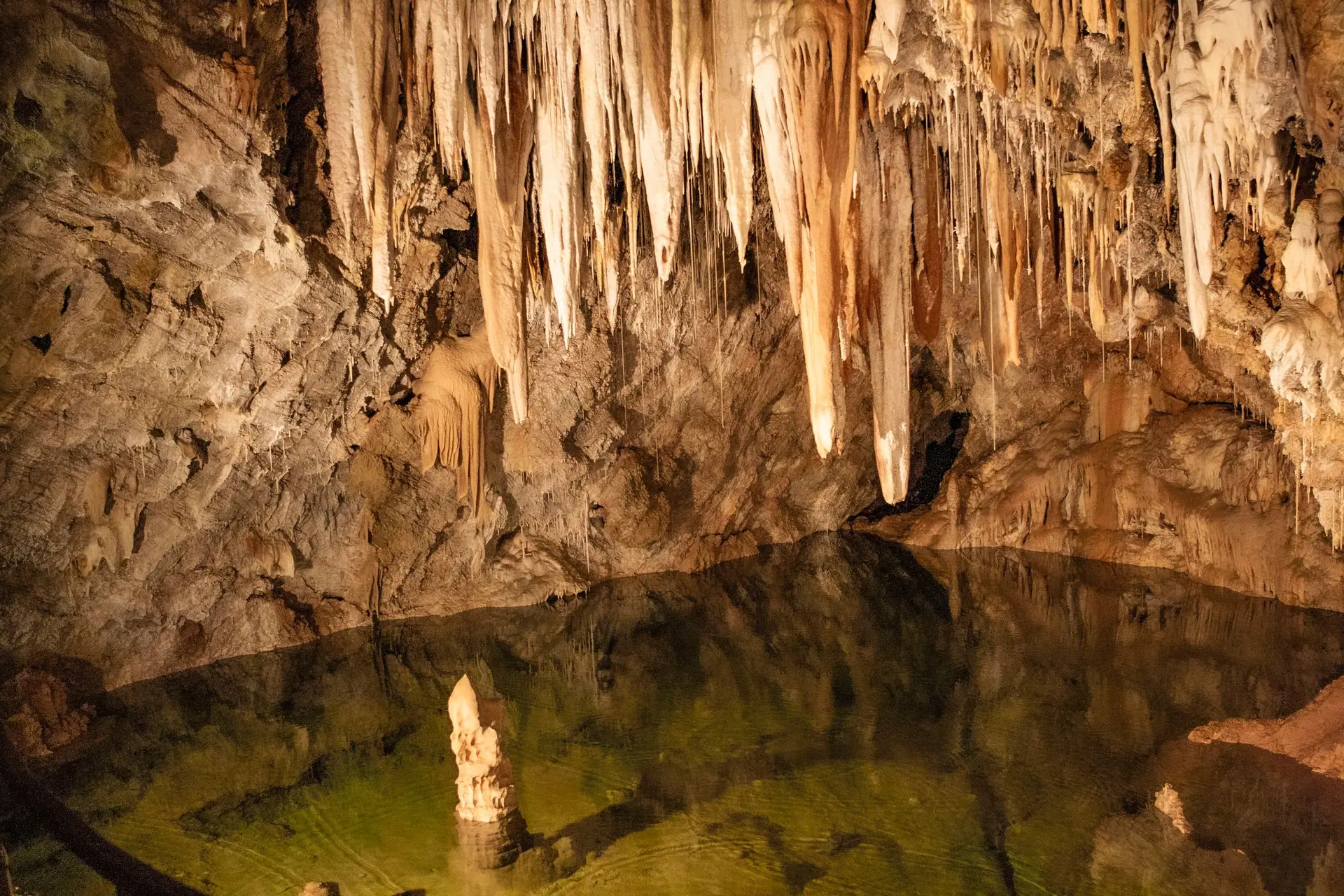
Why visit the Castellana Caves
It has to be said plainly: you don't come to Castellana Grotte for the town. You come for what lies beneath it.
This whole stretch of Puglia sits on a limestone plateau, the Murgia — the same rock that gives Polignano's cliffs their white and its sea caves their shape, and that gives the countryside its dry-stone walls. At Castellana, water has worked this rock for millennia, hollowing out a network of galleries beneath the olive groves that runs for more than three kilometres and drops to a hundred and twenty-two metres.
That contrast is what makes the visit memorable. You leave a countryside baking under the sun, go down a few dozen steps, and find yourself in a constant coolness, among columns of calcite that took centuries to form, drop by drop.
It's also, very practically, the outing to keep in reserve — the one for the day the pool alone won't do, or for building a bit of variety into a longer stay along this coast, a change of pace from cliffs and sea.
Two routes: which to choose
It's the only decision to make before you come, and it's worth two minutes of thought — because the two routes don't show the same thing.
The partial route covers around a kilometre and takes about fifty minutes. It starts at the Grave, the enormous entrance cavern, open to the sky — this is how the network was first discovered. It gives a fair sense of the place, and it's more than enough with young children or when time is short.
The full route covers three kilometres and takes around a hundred minutes. It begins the same way, then continues well beyond, as far as the Grotta Bianca — the last chamber, some fifteen hundred metres from the Grave, reached through a small opening cut into a wall of alabaster. It's what gives the site its reputation, and it's only visible on this route.
Our honest view: if you're making the trip, take the full route. The difference in time is about fifty minutes; the difference in what you see is far greater. The partial route mostly makes sense for tired legs or very young children.
One accessibility point worth knowing: an adapted route exists, descending by lift to the Grave and covering around four hundred metres to the Caverna della Fonte.
What you'll see underground
The visit begins at the Grave, and it's a spectacular start: an enormous cavern whose roof opens to the sky through a natural shaft. Daylight falls straight down into it, lighting a cone of rubble on the floor. This opening is how the network was first explored.
From there, you go deeper. The galleries follow one another, each with its own character: narrow passages bristling with stalactites, chambers where the formations take shapes you think you recognise, low vaults you have to duck under.
The full route ends at the Grotta Bianca. It takes its name from the colour of its calcite, an almost unreal white, considered among the purest to be seen in any cave. You reach it after a long approach, which only adds to the effect.
Preparing the visit
Three things worth knowing, and they're the difference between a good visit and a spoiled one.
First, the temperature. Underground, it stays between fourteen and eighteen degrees year-round. In August, with thirty-five outside, the gap is stark: bring something long-sleeved, even if it feels absurd packing it on your way out the door.
Then, footwear. The ground is damp and slippery in places, and the full route covers three kilometres with changes in level. Closed shoes, not flip-flops or beach sandals.
Finally, booking. Visits run exclusively in guided groups, at set times, with limited places per slot. In high season, turning up without a booking means risking a long wait, or being turned away. Check the caves' official website when you're planning your day, since opening times and admission vary by season.
A day from the masseria
Here's how we'd plan the day, assuming the full route and a visit in early afternoon — the slot that puts the hottest hours underground rather than in the sun.
And on the surface?
The town itself is a small Puglian community, with an old centre and narrow streets, pleasant enough for half an hour once you're back above ground — but it isn't a destination in its own right.
The location is convenient, though. Castellana sits inland, on the road that climbs towards the Valle d'Itria: Alberobello and its trulli are a quarter of an hour further on, Locorotondo barely beyond that. Many travellers combine the caves in the morning with a village in the valley in the afternoon — a reasonable way to shape a day if that's the direction your Puglia itinerary is taking.
We wouldn't recommend it if you're staying in the countryside, though. Fitting two visits into a single summer day means spending most of it in the car, and arriving back worn out — when the real luxury of staying out here is being able to come back for a swim mid-afternoon and head out again in the evening.
Frequently asked questions
- Do you need to book to visit the Castellana Caves?
- Yes, especially in high season. Visits run only in guided groups, at set times and with limited numbers. Turning up without a booking in July or August risks a long wait, or being turned away.
- Which route should you choose, the partial or the full one?
- The full route, if your legs are up to it: three kilometres and around a hundred minutes, but it's the only one that reaches the Grotta Bianca, the network's most striking chamber. The partial route, a kilometre in around fifty minutes, is still a good choice with young children or when time is tight.
- What's the temperature like in the caves?
- Between fourteen and eighteen degrees, constant year-round. The gap with the outside in summer is considerable: a long-sleeved layer is essential, even at forty degrees on the surface.
- Is the visit wheelchair accessible?
- An adapted route exists: it descends by lift to the Grave, the large entrance cavern, then covers around four hundred metres to the Caverna della Fonte. It doesn't reach the Grotta Bianca.
- How long does it take from Polignano a Mare?
- About twenty minutes' drive from the countryside between Polignano and Monopoli, heading inland away from the coast.
- Can you combine the caves and Alberobello in one day?
- Geographically, yes — the two are a quarter of an hour apart. But in summer, combining two visits means spending most of the day in the car and in the sun. If you're staying in the countryside, it's often better to keep the afternoon for the pool and go back another day.
Twenty minutes from the caves
Masseria 1863 is a countryside house for eight guests, with its own pool and olive garden, between Polignano a Mare and Monopoli.