Alberobello from the masseria
Thirty-five minutes on the road, two trulli quarters, and one rule that changes everything: get there before the coach tours do. Here's how we plan the day.
What you're here to see, and what to know before you go
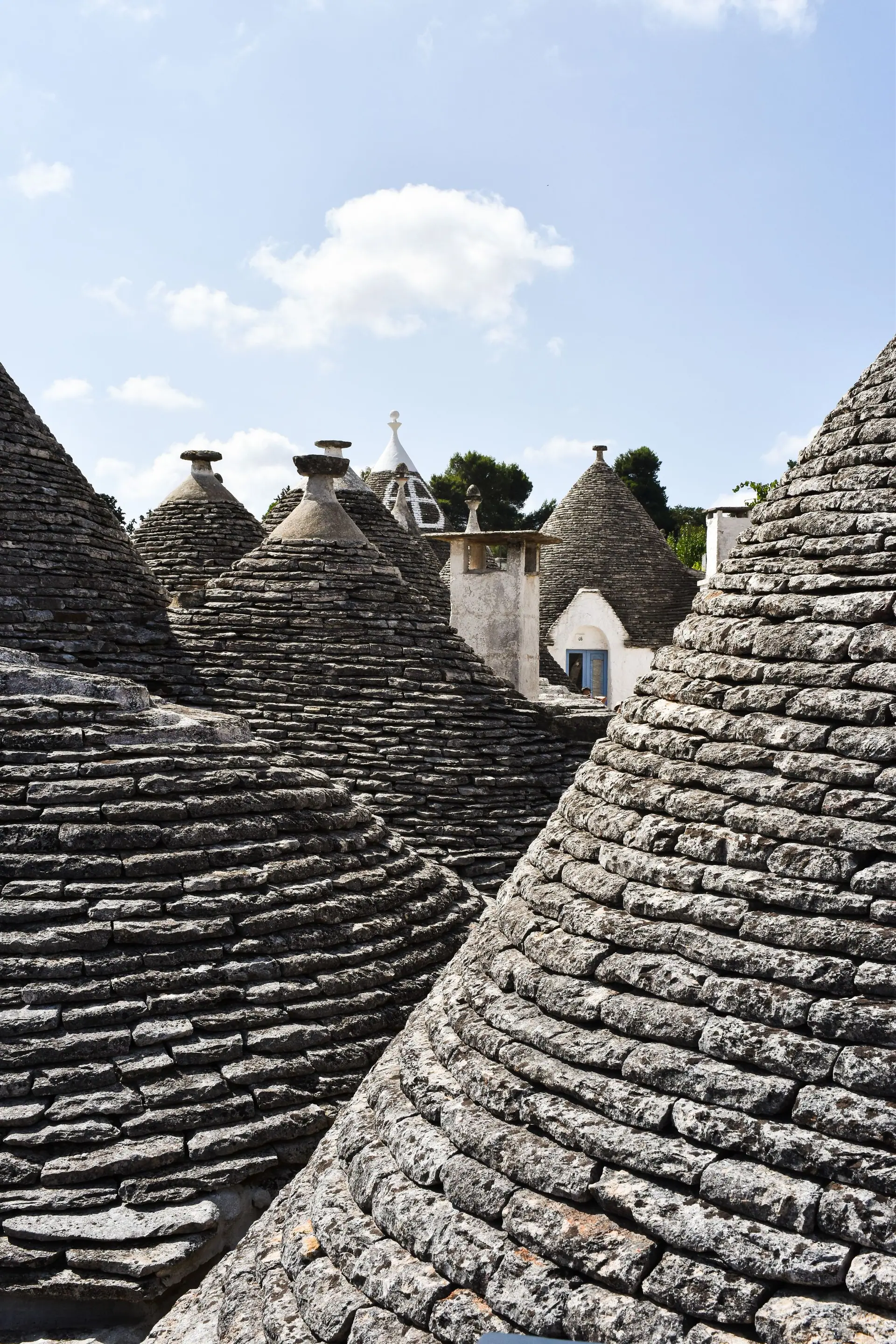
Alberobello is the most visited site in this part of Puglia, and it earns that status: there's nothing else quite like it anywhere. An entire town of cone-roofed, dry-stone houses, spread across two hills, inscribed as a UNESCO World Heritage Site since 1996.
A trullo isn't a decorative flourish. It's a limestone structure built by corbelling — circular courses of stone narrowing toward the top, laid without mortar. The technique is prehistoric, and it's still practised in the region today. Local legend has it that people built this way so the houses could be dismantled quickly ahead of a tax inspection; historians are more cautious about that story, but it says something true about how precarious these buildings once were.
That's the wonder of it. Now the honest part: Alberobello draws enormous crowds, coach tours unload by mid-morning, and Rione Monti turns into a corridor of souvenir shops once they arrive. That's not a reason to skip it — it's a reason to time it right.
That's exactly the advantage of staying thirty-five minutes away rather than three hours: you can get there early.
The two quarters, and the order to see them in
Rione Monti is the big quarter, the one from the photographs: around one thousand and thirty trulli packed onto a hillside, including the well-known Trulli Siamesi, two fused cones with a story attached about feuding brothers. It's also the one that fills up first, and most densely — most of its ground floors have become shops.
Aia Piccola is the other side of town, and it's a complete contrast: five hundred and ninety trulli, still largely lived in, with almost no shops. You walk down empty lanes here while, two hundred metres away, a crowd shuffles past. This is where you understand what a trulli town actually is.
The Trullo Sovrano, set apart from both quarters, is the only two-storey trullo in town. Its walls are two metres seventy thick, and it still holds its original early-twentieth-century furniture — it gives a sense of the interior that no shop can.
Our order, and it matters: Rione Monti first, early, while it's still quiet; Aia Piccola after, once the crowds arrive — because they don't go there. It's the reverse of what most visitors do, which is exactly why it works.
The day, hour by hour
Here's the plan we'd suggest, built around one idea: see the big quarter before everyone else does, and be back in time for a swim.
Extend the day, or not
Alberobello sits at the heart of the Valle d'Itria, and it's tempting to keep going: Locorotondo is a few minutes away, Martina Franca a little further, Ostuni half an hour on.
It's doable, and plenty of travellers do it — because they're staying far away and won't be passing through again. That's not your situation. When the house is thirty-five minutes away, stringing three villages together in a single summer day means spending the afternoon in the car and arriving back too tired to enjoy the evening, which is the best part of the day out here.
So our advice runs against the usual instinct: one town per outing, early in the morning, and the rest of the day at the house. Over a week you'll see just as much — and you'll have actually seen it.
Frequently asked questions
- What time should you arrive in Alberobello?
- As early as possible. Coach tours arrive by mid-morning and Rione Monti gets very crowded once they do. Leaving around half past eight from the countryside near Polignano gets you there by about nine, while the lanes are still empty.
- How long does it take to see Alberobello?
- Half a day is plenty for both quarters and the Trullo Sovrano, without rushing. Guides that recommend two days are usually written for travellers staying in town; from the surrounding countryside, it's easier to come back a second time at a different hour instead.
- What's the difference between Rione Monti and Aia Piccola?
- Rione Monti is the larger quarter, around one thousand and thirty trulli, busy with shops and visitors. Aia Piccola has five hundred and ninety, stays largely residential, and has almost no shops — it's the quarter where you understand what a trulli town actually is.
- Can you go inside a trullo?
- Yes. The Trullo Sovrano, the only two-storey trullo in town, is open to visitors and keeps its early-twentieth-century furniture. Many shops in Rione Monti let you step inside too, though most of what they show is a fitted-out shop rather than a home.
- How long is the drive from Polignano a Mare?
- About thirty-five minutes from the countryside between Polignano and Monopoli, heading inland away from the coast toward the Valle d'Itria.
- Should you combine Alberobello and Locorotondo in one day?
- It's easy enough geographically, but we wouldn't recommend it if you're staying nearby. Combining two villages in summer means an afternoon in the car and coming back exhausted. One town per outing, early in the morning, leaves the rest of the day for the countryside.
Thirty-five minutes from the trulli
Masseria 1863 is a countryside house for eight guests, with its own pool and olive garden, between Polignano a Mare and Monopoli.