Ostuni from the masseria
A forty-five-minute drive, a town whitewashed from top to bottom across three hills, and a rule that changes everything: go late, not early. Here's how we plan the visit.
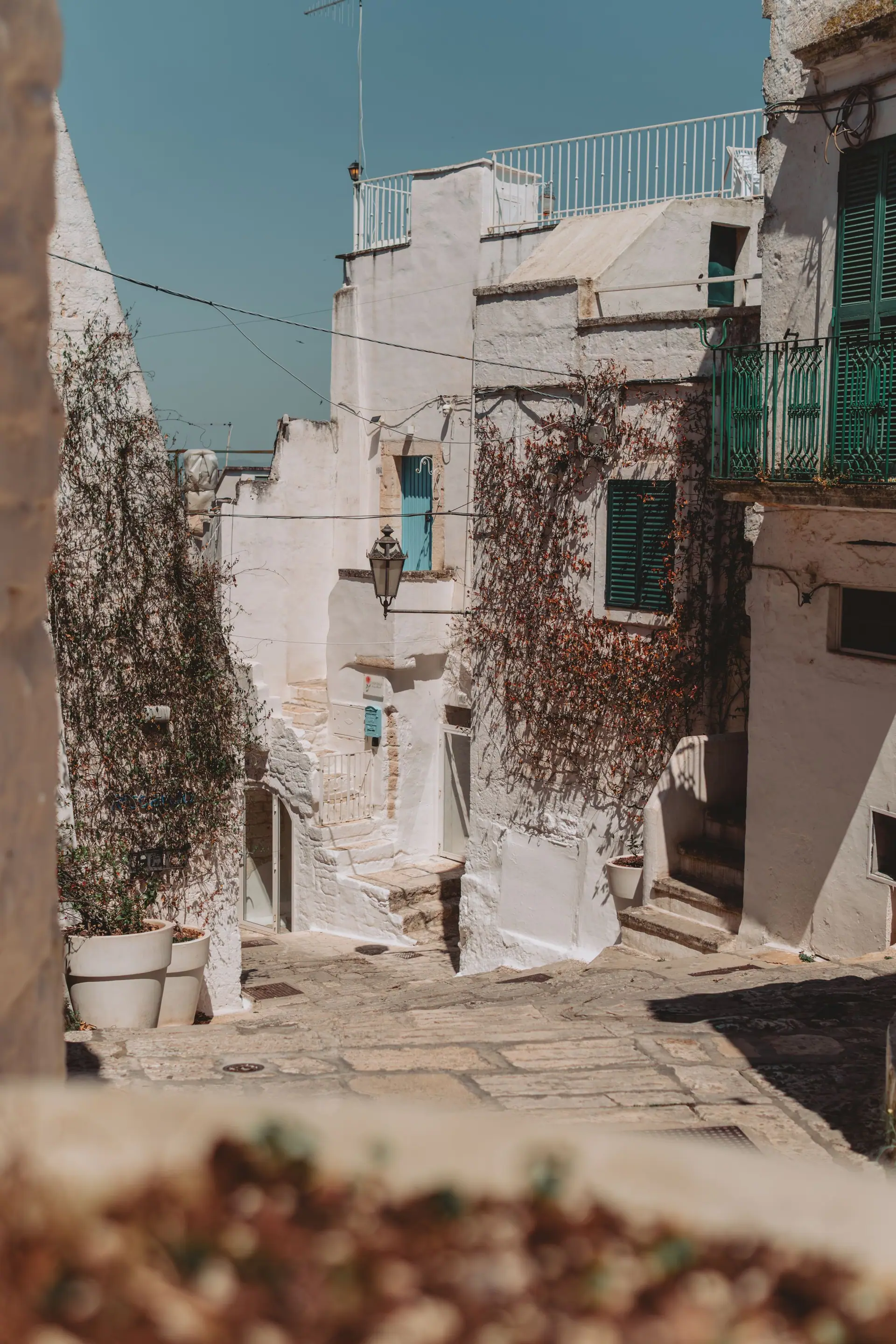
Why the White City
You see Ostuni long before you reach it. The town appears from a distance, a white patch stepped across its hills above an olive plain that runs all the way down to the sea. It's one of the most striking approaches in the region, and reason enough on its own to take the coastal road rather than the motorway.
The whiteness isn't a recent affectation. The historic centre has been whitewashed for centuries, and local tradition links the practice to outbreaks of plague: lime is a natural disinfectant, cheap and available everywhere, and Ostuni is said to have been largely spared as a result. The story is probably embellished, but the habit has stuck — the façades are still redone today.
What's worth understanding before you go is that the town is vertical. The lanes climb, often turning into stepped alleys, and the historic centre is walked in its entirety — there's no flat route through it. It's a genuine climb: pleasant in the cool of the day, exhausting at three in the afternoon in August.
The time of day makes all the difference
This is the real advice on this page, and it follows directly from the geography: Ostuni means steep climbs and glaring white walls. At midday in summer the town is an oven, and the light flattens everything — photographs taken then are no good either, everything comes out blown out and white.
Late in the afternoon, the same town becomes something else. Low light rakes across the whitewash and gives it texture, the temperature turns bearable again, locals come back out, and the terraces at the high points fill up just as the sun drops over the olive plain.
So our advice here is the opposite of Alberobello: there, you go early to beat the tour groups; here, you go late to beat the heat and catch the light. Both towns reward choosing your time carefully — just not the same time.
A word on parking: the historic centre is largely closed to cars and access is restricted. You park in the lower town and walk up — which is part of the experience.
The evening, hour by hour
The schedule we'd suggest, built around the light rather than opening hours.
The olive plain
Between Ostuni and the sea stretches one of the largest olive groves in Europe, planted with trees many of which are a thousand years old — huge, twisted, hollowed-out trunks that still bear fruit.
The road across this plain is a reason to come in its own right. It's driven slowly, between dry-stone walls, and you regularly pass fortified masserie — some in ruins, others restored.
If you have time on the way back, take the coastal road rather than the inland one: it meets the sea near Torre Canne, then runs back up towards Monopoli. It adds about a quarter of an hour and is far more beautiful at sunset.
Frequently asked questions
- Why is Ostuni white?
- Its historic centre has been whitewashed for centuries. Local tradition links the practice to outbreaks of plague: lime is a natural disinfectant, cheap and readily available, and the town is said to have been largely spared as a result. The habit has stuck, and the façades are still kept up today.
- What time of day should you visit Ostuni?
- Late in the afternoon, the opposite of Alberobello. The town is built across three hills, the visit is a continuous climb, and the whitewash reflects the light strongly: at midday in summer it's punishing and the light flattens everything. Later in the day, the town gains texture and the temperature turns bearable.
- Can you drive into the historic centre?
- Barely: the centre is largely closed to vehicles and access is restricted. You park in the lower town and walk up — the climb is part of the visit.
- How long does it take to visit Ostuni?
- Two to three hours to wander the historic centre, longer if you stay for dinner. The climbing means you move more slowly than you'd expect.
- How long is the drive from Polignano a Mare?
- About forty-five minutes heading south-east. Taking the coastal road rather than the motorway gives you the view of the white town as you approach.
Forty-five minutes from the White City
Masseria 1863 is a countryside house for eight guests, with its own pool and olive garden, between Polignano a Mare and Monopoli.